

First 10 Minutes of a Medical Emergency: Is Your Facility Ready?
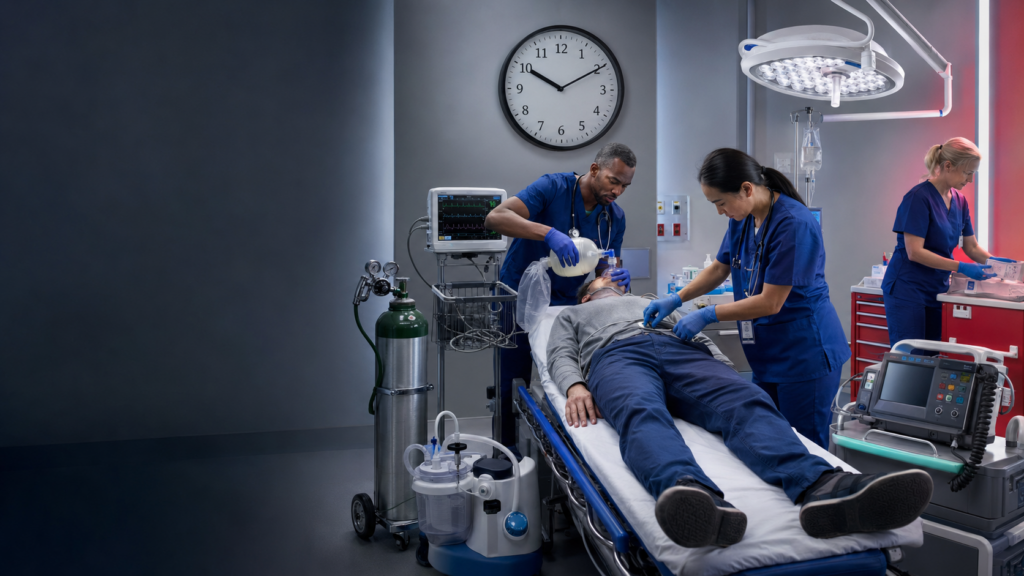
First 10 Minutes of a Medical Emergency—and Does Your Facility Have Everything It Needs?
A patient suddenly collapses in the waiting area.
For a moment, everyone freezes. Then the questions begin:
“Is the patient breathing?”
“Where is the emergency trolley?”
“Is the oxygen cylinder full?”
“Who is calling for additional help?”
In a medical emergency, ten minutes can feel incredibly short. Yet within that brief window, healthcare workers may need to identify a life-threatening problem, mobilise a response team, locate essential equipment, begin stabilisation and arrange further treatment or referral.
Clinical skill is critical—but skill alone is not enough. The right equipment must be available, functional, fully stocked and within immediate reach.
So, what typically happens during those first ten minutes, and how prepared is your facility?
Important: This article provides general facility-readiness information. Emergency care should only be delivered by appropriately trained personnel following approved clinical protocols.
Minute 0–1: Recognising That Something Is Wrong
Medical emergencies do not always begin dramatically. A patient may simply become unusually quiet, confused, breathless, weak or unresponsive.
The first minute is about recognising the warning signs and activating the facility’s emergency-response system. Staff may need to:
- Check the immediate environment for danger
- Assess the patient’s responsiveness
- Call for clinical assistance
- Activate the emergency or resuscitation team
- Bring the emergency trolley and relevant equipment
- Record the time the incident began
A delayed response can happen when staff are unsure whom to call or where emergency supplies are kept. Every team member—including reception, security and support staff—should understand how to raise the alarm.
Minute 1–3: A Rapid, Structured Assessment Begins
Once trained responders arrive, they usually perform a systematic initial assessment. One widely recognised framework is the ABCDE approach:
- A – Airway: Is the airway open and protected?
- B – Breathing: Is the patient breathing effectively?
- C – Circulation: Is there adequate circulation, and is severe bleeding present?
- D – Disability: What is the patient’s level of consciousness?
- E – Exposure: Are there injuries, rashes, burns or other important findings?
The purpose is not to establish every detail of the diagnosis immediately. It is to identify and address the problems most likely to threaten life.
The Resuscitation Council UK advises treating life-threatening problems as they are found, calling for help early and reassessing the patient regularly. The WHO Basic Emergency Care programme similarly promotes a systematic approach to time-sensitive illness and injury.
Minute 3–5: Monitoring and Immediate Intervention
At this stage, several actions may happen simultaneously. Depending on the emergency and the facility’s protocols, trained clinicians may:
- Measure blood pressure, pulse and oxygen saturation
- Attach the patient to a multiparameter or cardiac monitor
- Check blood glucose
- Provide airway or breathing support
- Control severe external bleeding
- Establish vascular access
- Prepare emergency medicines
- Begin CPR and use a defibrillator if cardiac arrest is confirmed
This is where equipment readiness becomes visible.
A pulse oximeter without working batteries, an empty oxygen cylinder, a suction machine with missing tubing or a defibrillator that has not been checked can interrupt the response at the worst possible moment.
Emergency equipment should never merely be present. It must be ready to use.
Minute 5–7: The Team Organises Around the Patient
An effective emergency response is rarely a one-person effort. Clear roles help the team work quickly without duplicating tasks or overlooking essential actions.
One person may lead the clinical response while others:
- Manage the airway
- Monitor and document vital signs
- Prepare equipment and medication
- Communicate with the laboratory, theatre or higher-level team
- Contact an ambulance or referral facility
- Speak with the patient’s relatives
- Record interventions and the patient’s response
Clear communication is just as important as clinical equipment. When instructions are vague—or everyone assumes someone else has completed a task—valuable time can be lost.
Regular drills can help staff practise leadership, role allocation, equipment use and patient handover before a real emergency occurs.
Minute 7–10: Reassessment and the Next Decision
Emergency care does not stop after the first intervention. The patient must be reassessed to determine whether their condition is improving, deteriorating or remaining unchanged.
The team may need to decide whether the patient requires:
- Continued stabilisation within the facility
- Advanced airway or critical-care support
- Emergency surgery
- Urgent diagnostic investigations
- Transfer to a higher-level facility
- Safe, monitored transport
Referral arrangements should begin early when a patient may require services that are unavailable on site. A reliable ambulance stretcher, portable oxygen supply, transport monitor and organised handover information can help maintain continuity of care during transfer.
Does Your Facility Have the Essential Equipment?
Every facility’s requirements will depend on its services, patient population, staffing and national regulations. However, a well-prepared emergency or resuscitation area may require equipment across the following categories.
Airway and breathing equipment
- Oxygen cylinders or a dependable central oxygen supply
- Flowmeters and appropriate oxygen-delivery accessories
- Manual resuscitators in suitable sizes
- Suction machine with compatible tubing and catheters
- Airway-management accessories
- Nebulizer
- Portable oxygen equipment for transfers
Monitoring and assessment equipment
- Pulse oximeter
- Blood-pressure monitor with different cuff sizes
- Stethoscope
- Thermometer
- Glucometer with valid test strips
- Multiparameter patient monitor
- ECG machine, where appropriate
Resuscitation equipment
- Clearly organised emergency trolley
- Automated external defibrillator or manual defibrillator
- CPR board
- Emergency medicines appropriate to the facility’s protocols
- IV stands and vascular-access supplies
- Clock or timer for documenting interventions
Trauma and patient-handling equipment
- Emergency stretcher
- Ambulance stretcher
- Wheelchair
- Cervical collars in appropriate sizes
- Splints
- Spine board or other approved patient-movement equipment
- Haemorrhage-control supplies
- Examination light
Infection prevention and staff protection
- Medical gloves
- Masks and eye protection
- Protective gowns or aprons
- Hand-hygiene supplies
- Sharps containers
- Clinical-waste bins
Having these items on an inventory sheet does not automatically make a facility emergency-ready.
Five Questions Every Facility Should Ask Today
1. Can staff reach the equipment immediately?
Emergency supplies should be clearly labelled, logically arranged and located where trained staff can access them without unnecessary delay.
2. Is every item functional?
Equipment should be inspected according to the manufacturer’s instructions and the facility’s maintenance programme. Batteries, cables, seals, accessories and oxygen levels require routine checks.
3. Are medicines and consumables within their expiry dates?
Emergency trolleys should have a documented checking schedule. Used, damaged or expired items must be replaced promptly.
4. Has the team been trained to use the equipment?
A sophisticated monitor or defibrillator offers little value if the available staff cannot operate it confidently and safely. Training should reflect each employee’s professional role and scope of practice.
5. Has the entire response system been tested?
Simulated emergencies can reveal hidden weaknesses, including unclear roles, locked storage areas, missing accessories and poorly understood referral procedures.
The WHO Emergency Care Toolkit includes structured tools intended to strengthen clinical capacity, emergency processes, documentation and referrals—particularly in resource-limited settings.
Preparedness Is More Than Purchasing Equipment
A dependable emergency-care system brings together four essential elements:
People, protocols, equipment and practice.
Your facility needs trained staff who can recognise deterioration, clear procedures that guide the response, reliable equipment that is ready for immediate use and regular practice that keeps the entire system working together.
Buying emergency equipment is therefore not the final step. It is the beginning of an ongoing commitment to maintenance, staff training, stock management and quality improvement.
When the Emergency Comes, Preparation Should Already Be Complete
No healthcare facility can predict exactly when a patient will collapse, experience severe breathing difficulty, develop shock or suffer a serious injury.
What the facility can control is its readiness.
The first ten minutes should not be spent searching for oxygen, looking for a missing suction tube or discovering that an emergency device has no power. They should be spent delivering organised, timely and appropriate care.
Is your facility ready for those ten minutes?
Medjet Hospital Supplies provides dependable emergency-care, resuscitation, monitoring, oxygen-therapy and patient-transport equipment for hospitals, clinics and other healthcare institutions.
Contact Medjet Hospital Supplies today for an emergency-equipment assessment and a quotation tailored to your facility’s needs.
Related Articles
Medical Equipment Maintenance Planning: Questions to Ask Before You Buy
August 27, 2026
No Comments
Read More »
2026 Maternity Equipment Checklist for Clinics and Hospitals in Kenya
August 3, 2026
No Comments
Read More »
First 10 Minutes of a Medical Emergency: Is Your Facility Ready?
July 27, 2026
No Comments
Read More »