
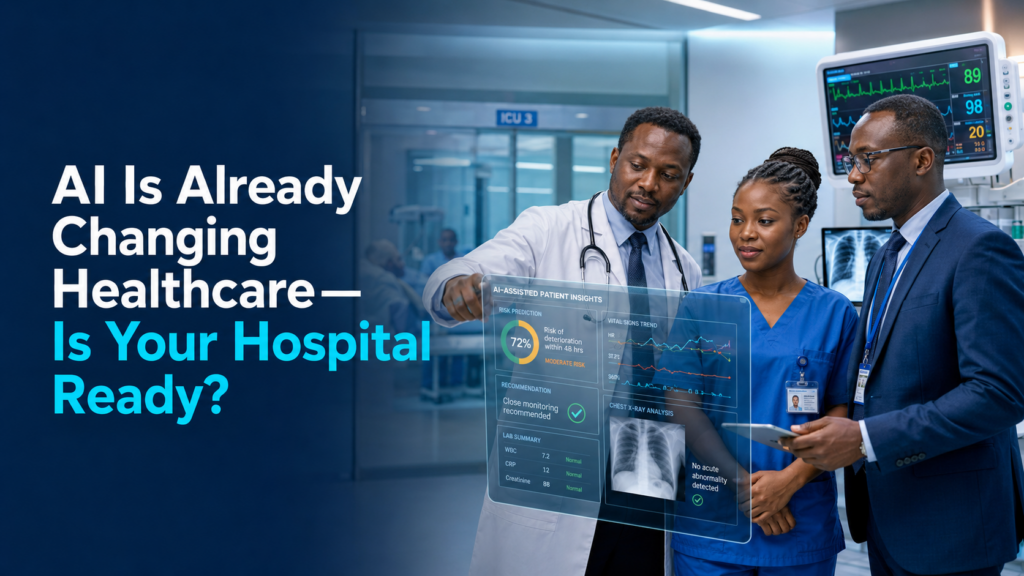
Artificial intelligence is no longer a distant promise reserved for futuristic hospitals.
It is already helping healthcare facilities interpret medical images, monitor patients, streamline documentation, manage inventory and identify clinical risks earlier. In some facilities, AI works quietly inside diagnostic equipment and hospital software—meaning clinicians may already be using it without describing it as “AI.”
The real question is therefore no longer:
“Will artificial intelligence enter healthcare?”
It is:
“Is your hospital ready to use it safely, effectively and responsibly?”
For hospitals in Kenya and across Africa, becoming AI-ready does not necessarily mean purchasing expensive robots or replacing existing medical equipment. It means building the right foundation: reliable equipment, clean data, trained staff, secure systems, practical workflows and clear accountability.
Hospitals that establish this foundation now will be better positioned to adopt new technology without wasting money, disrupting clinical care or exposing patients to unnecessary risks.
What Does AI in Healthcare Actually Mean?
Artificial intelligence refers to computer systems that can analyse information, identify patterns and produce predictions or recommendations.
In healthcare, these systems may assist professionals with tasks such as:
- Identifying abnormalities in medical images
- Flagging deteriorating patients
- Supporting clinical documentation
- Predicting equipment maintenance needs
- Automating repetitive administrative work
- Managing medicine and consumable inventories
- Monitoring patients remotely
- Supporting treatment and resource-planning decisions
AI should not be viewed as a substitute for doctors, nurses, biomedical engineers or other healthcare professionals. Its greatest value lies in helping qualified teams work with better information, greater consistency and less avoidable administrative pressure.
The World Health Organization emphasises that healthcare AI should protect patient autonomy and safety while remaining transparent, accountable, inclusive and sustainable. In other words, an AI system must do more than appear technologically impressive—it must deliver responsible, measurable value. World Health Organization
Seven Ways AI Is Already Changing Healthcare
1. Supporting medical imaging and diagnosis
Radiology is one of the most visible areas of healthcare AI.
AI-enabled software can assist clinicians in analysing X-rays, CT scans, mammograms, ultrasound images and other diagnostic studies. It may highlight suspicious areas, prioritise urgent cases or support the measurement of anatomical structures.
This can be particularly valuable where imaging workloads are high or specialist availability is limited. However, an AI-generated result must still be interpreted alongside the patient’s history, symptoms, laboratory results and professional clinical judgement.
The growing use of AI-enabled medical devices is already significant enough for the US Food and Drug Administration to maintain a dedicated list of authorised AI-enabled devices. This illustrates that AI in medical equipment is no longer merely experimental. US Food and Drug Administration
2. Detecting patient deterioration earlier
Modern patient monitors generate large amounts of information, including heart rate, oxygen saturation, blood pressure, respiratory rate and temperature.
AI-assisted systems can examine changes across several measurements and identify patterns that may indicate deterioration. This could help clinical teams recognise potential complications earlier than they would by looking at a single reading in isolation.
The technology is most effective when hospitals also have:
- Dependable monitoring equipment
- Correctly positioned sensors
- Reliable connectivity
- Clearly configured alarm limits
- Staff who understand the alerts
- A defined escalation process
An intelligent warning is only valuable if it reaches the right person and leads to timely action.
3. Reducing the documentation burden
Clinicians frequently spend substantial time entering notes, preparing reports and completing administrative records.
Generative AI tools may help structure clinical notes, summarise information or draft routine documents. Used appropriately, this could allow healthcare professionals to spend more time on direct patient care.
Nevertheless, AI-generated clinical text must always be reviewed. These systems can produce inaccurate, incomplete or misleading information with considerable confidence. Sensitive patient data should also never be entered into an unapproved public AI platform.
In its guidance on generative AI for health, WHO calls for appropriate governance, transparency and post-deployment auditing to protect patients and health systems. WHO guidance on AI for health
4. Improving hospital inventory management
Hospitals must balance two costly risks: running out of critical supplies and holding excessive stock that expires before use.
AI-supported inventory systems can analyse consumption patterns, lead times, seasonal changes and historical demand. They may help procurement teams anticipate when items such as test reagents, gloves, oxygen accessories or theatre consumables will need to be replenished.
This does not eliminate the need for professional procurement oversight. Unexpected outbreaks, supplier disruptions and changing clinical programmes can all affect demand. AI can strengthen planning—but it cannot take responsibility for it.
5. Predicting equipment maintenance requirements
Traditional equipment maintenance is often either reactive or calendar-based. Reactive maintenance waits for a failure, while calendar-based maintenance services equipment at fixed intervals regardless of how heavily it has been used.
Predictive maintenance introduces another possibility.
By examining operating hours, error codes, temperature, battery condition and performance trends, connected systems may help biomedical teams identify equipment that is likely to require attention.
This could reduce:
- Unexpected equipment failure
- Clinical service interruptions
- Emergency repair expenses
- Premature replacement
- Risks associated with equipment downtime
The effectiveness of predictive maintenance still depends on something very practical: hospitals must maintain accurate asset registers and service records.
6. Expanding remote monitoring
Connected devices can allow healthcare teams to monitor selected patients beyond the hospital building.
Depending on the care programme, data may be collected from blood pressure monitors, glucose meters, pulse oximeters, ECG devices or other approved equipment. AI can help identify unusual trends and prioritise patients who may require follow-up.
This could support chronic disease management, post-discharge care and healthcare delivery in underserved areas. But facilities must first determine who receives alerts, how quickly they are reviewed and what action should follow.
7. Strengthening operational planning
AI can also support non-clinical hospital decisions.
It may help analyse:
- Patient-flow patterns
- Bed occupancy
- Theatre utilisation
- Appointment demand
- Staffing requirements
- Laboratory turnaround times
- Equipment utilisation
Used carefully, these insights can help hospital managers direct limited resources toward the areas where they can create the greatest clinical and operational impact.
Kenya’s Healthcare AI Conversation Has Already Started
Kenya is actively advancing digital health, health information exchange, interoperability and artificial intelligence as important national priorities. The Ministry of Health has also highlighted proposals to strengthen AI-related clinical and data-science capacity, including an AI-in-Health Centre of Excellence at Kenyatta National Hospital. Kenya Ministry of Health
This makes hospital readiness especially important.
The facilities that benefit most from the next generation of healthcare technology will not necessarily be those that purchase the most sophisticated systems first. They will be those that can integrate technology into real clinical workflows, maintain it properly and demonstrate that it improves care.
Is Your Hospital AI-Ready? An Eight-Point Assessment
1. Do you have a clear problem to solve?
“Implementing AI” is not a useful objective on its own.
Begin with a specific operational or clinical problem, such as:
- Long radiology reporting times
- Unplanned equipment downtime
- Frequent stock-outs
- Excessive documentation
- Missed patient deterioration
- Poor visibility of hospital assets
Once the problem is defined, the hospital can determine whether AI is genuinely the right solution.
2. Is your medical equipment digitally capable?
AI depends on access to reliable information.
Hospital leaders should assess whether key equipment can export, share or integrate data using appropriate formats. A device does not need to have “AI” printed on its casing, but it should ideally fit into the hospital’s long-term digital plan.
Before purchasing new equipment, ask:
- Can the device integrate with our existing systems?
- Who owns the data it produces?
- Can we export that data in a usable format?
- Does the device require a permanent internet connection?
- What happens when connectivity is interrupted?
- Will software updates attract additional fees?
- Is local technical support available?
- How long will cybersecurity updates be provided?
These questions can prevent a hospital from acquiring advanced equipment that later becomes an isolated technological island.
3. Is your data accurate and complete?
AI cannot repair a poorly designed data environment automatically.
Incomplete records, inconsistent terminology, duplicated patient files and incorrectly labelled images can all weaken performance. An algorithm trained or operated with unsuitable data may generate misleading results.
Hospitals should therefore strengthen:
- Data collection standards
- Patient identification processes
- Device calibration procedures
- Clinical coding
- Data storage
- Access controls
- Backup systems
- Record retention policies
AI readiness begins with data discipline.
4. Are privacy and cybersecurity protections in place?
Healthcare data is extremely sensitive. Connected medical devices and cloud-based applications can create new access points that must be protected.
Before deploying an AI-enabled system, hospitals should establish:
- Role-based access
- Strong authentication
- Secure backups
- Device and software update procedures
- Vendor access controls
- Incident-response plans
- Rules governing patient-data use
- Clear procedures for removing access when staff leave
Cybersecurity is not only an IT issue. It is a patient-safety and organisational-resilience issue.
5. Have staff been involved?
Technology imposed on healthcare workers frequently creates resistance, workarounds and unintended risks.
Doctors, nurses, biomedical engineers, ICT professionals, administrators and procurement teams should be involved before implementation. Each group sees different risks and workflow requirements.
Staff also need training that answers practical questions:
- What does the system do?
- What does it not do?
- How should its output be interpreted?
- When can an alert be overridden?
- Who is responsible when the system is incorrect?
- How should a suspected failure be reported?
AI literacy will increasingly become an important hospital competency.
6. Is there human oversight?
Every AI-assisted clinical process should have an accountable human decision-maker.
Hospitals should define who reviews recommendations, who can override them and how disagreements are documented. The level of oversight should reflect the potential harm associated with an incorrect result.
AI can support professional judgement. It should not create a responsibility gap.
7. Has the solution been validated for your setting?
A system that performs well in one population, hospital or country may not produce identical results in another.
Before scaling an AI solution, ask the supplier for evidence covering:
- The intended clinical use
- The populations used in testing
- Accuracy and error rates
- Known limitations
- Relevant regulatory status
- Performance under local conditions
- How performance is monitored after deployment
WHO recommends risk management, external validation, transparency, data quality and ongoing performance monitoring as central considerations for healthcare AI. WHO regulatory considerations
8. Can you measure whether it works?
A successful AI project should improve a defined outcome—not simply demonstrate that the hospital is technologically modern.
Possible performance indicators include:
- Reduced reporting time
- Fewer missed appointments
- Lower equipment downtime
- Improved stock availability
- Faster escalation of critical cases
- Reduced administrative time
- Improved diagnostic consistency
- Lower cost per completed procedure
If benefits cannot be measured, the hospital cannot determine whether the investment should be expanded, modified or discontinued.
The Biggest Mistake Hospitals Can Make
The greatest mistake is not necessarily adopting AI too slowly.
It is adopting it without preparation.
Buying AI-enabled equipment before addressing connectivity, maintenance, data quality, staff training and workflow integration can produce an expensive system that clinicians do not trust and managers cannot evaluate.
A smarter approach is to start small.
Choose one clearly defined problem. Establish a baseline. Pilot a suitable solution in a controlled department. Train the team. Monitor safety and performance. Gather feedback. Improve the workflow before expanding.
This approach turns AI adoption from a high-risk technology purchase into a manageable improvement programme.
What Procurement Teams Should Ask AI-Technology Suppliers
When evaluating an AI-enabled medical device or healthcare system, procurement teams should ask:
- What exact clinical or operational problem does the system solve?
- Is the AI feature essential, optional or subscription-based?
- What evidence supports its performance?
- Has it been validated on populations relevant to our patients?
- What are its known limitations and failure modes?
- Does it continue working when the internet is unavailable?
- How is patient information stored and protected?
- Can it integrate with our existing equipment and software?
- How frequently is the algorithm updated?
- Could an update change its clinical performance?
- Who provides installation, training and technical support?
- What are the complete five-year ownership costs?
- Can the hospital export its data if it changes suppliers?
- What happens if the vendor discontinues the product?
These questions help move procurement beyond attractive demonstrations and toward patient safety, interoperability and long-term value.
The Hospital of the Future Is Built Through Today’s Decisions
The AI-ready hospital is not defined by robots in every corridor.
It is a facility where equipment communicates effectively, data is trustworthy, cybersecurity is taken seriously, staff understand the technology and every digital investment supports a measurable healthcare outcome.
Artificial intelligence will continue to influence diagnosis, monitoring, maintenance, procurement and hospital management. But the hospitals that benefit most will be those that combine innovation with strong clinical governance and practical infrastructure.
At Medjet Hospital Supplies, we believe modernisation should begin with the right questions—not the most fashionable technology. Our role is to help healthcare facilities evaluate dependable medical equipment, plan for integration, strengthen lifecycle support and invest with the future in mind.
Is your facility planning its next stage of digital transformation? Talk to Medjet Hospital Supplies about medical equipment solutions designed around your clinical needs, operational goals and long-term growth.
Frequently Asked Questions
How is AI used in healthcare?
AI is used to support medical-image analysis, patient monitoring, clinical documentation, inventory forecasting, predictive equipment maintenance, remote care and hospital resource planning.
Will AI replace doctors and nurses?
AI is more likely to assist healthcare professionals than replace them. Clinical decisions require context, empathy, accountability and professional judgement that cannot safely be delegated entirely to an algorithm.
What is an AI-ready hospital?
An AI-ready hospital has reliable digital infrastructure, accurate data, compatible medical equipment, cybersecurity controls, trained staff, defined clinical oversight and a process for measuring outcomes.
What are the risks of AI in hospitals?
Potential risks include incorrect recommendations, biased results, privacy breaches, cyberattacks, automation bias, poor integration and unclear accountability. Governance and ongoing monitoring are therefore essential.
How can a hospital begin adopting AI?
Start with one clearly defined problem. Review current data and infrastructure, select a validated solution, conduct a controlled pilot, train staff and measure results before expanding.
Should hospitals replace all existing equipment to prepare for AI?
No. Hospitals should first assess whether existing equipment can be maintained, upgraded or integrated. A phased equipment plan is usually more practical than replacing everything simultaneously.
Order from MJ Hospital Supplies today and get free delivery.
You can also follow us on our: Facebook Page: Mj Hospital Supplies for more updates.
Instagram Page:https://www.instagram.com/medjet_hospital/
Pinterest page: https://www.pinterest.com/mjhospitalsupplies/
Linked in page: https://www.linkedin.com/company/medjet-hospital-supplies-ltd/
Twitter Page: https://twitter.com/medjethospital