


4
Healthcare technology has transformed the way clinicians diagnose, monitor, and treat patients. Yet one question we frequently hear from hospitals, clinics, NGOs, and healthcare professionals is:
“What’s the difference between POCUS, Ultrasound, and Doppler?”
Many people use these terms interchangeably, but they are not the same thing. Understanding the differences helps healthcare facilities invest in equipment that truly matches their clinical needs, improves patient outcomes, and maximizes return on investment.
At Medjet Hospital Supplies Ltd, we believe procurement decisions should be based on clinical impact—not just specifications or price tags.
Let’s break it down.
First Things First: Ultrasound Is the Technology


Ultrasound is an imaging technology that uses high-frequency sound waves to create real-time images of structures inside the body.
Unlike X-rays or CT scans, ultrasound:
- Uses no ionizing radiation
- Produces live images
- Is safe for repeated use
- Is painless and non-invasive
- Can be used across nearly every medical specialty
Ultrasound has become one of the most versatile diagnostic tools in modern medicine.
Common Applications
- Pregnancy monitoring
- Abdominal examinations
- Liver and kidney assessment
- Cardiac imaging
- Musculoskeletal injuries
- Thyroid examinations
- Pediatric imaging
- Emergency medicine
Think of ultrasound as the platform upon which many imaging techniques—including Doppler and POCUS—are built.
Portable Ultrasound:https://mjhospitalsupplies.co.ke/product/portable-ultrasound-machine/
3/4D Ultrasound Machine: https://mjhospitalsupplies.co.ke/product/ultrasound-machines/
Mindray Ultrasound Machine:https://mjhospitalsupplies.co.ke/product/ultrasound-machine/
What Is POCUS?
POCUS stands for Point-of-Care Ultrasound.
It is not a different machine or a different technology.
Rather, it is how ultrasound is used.
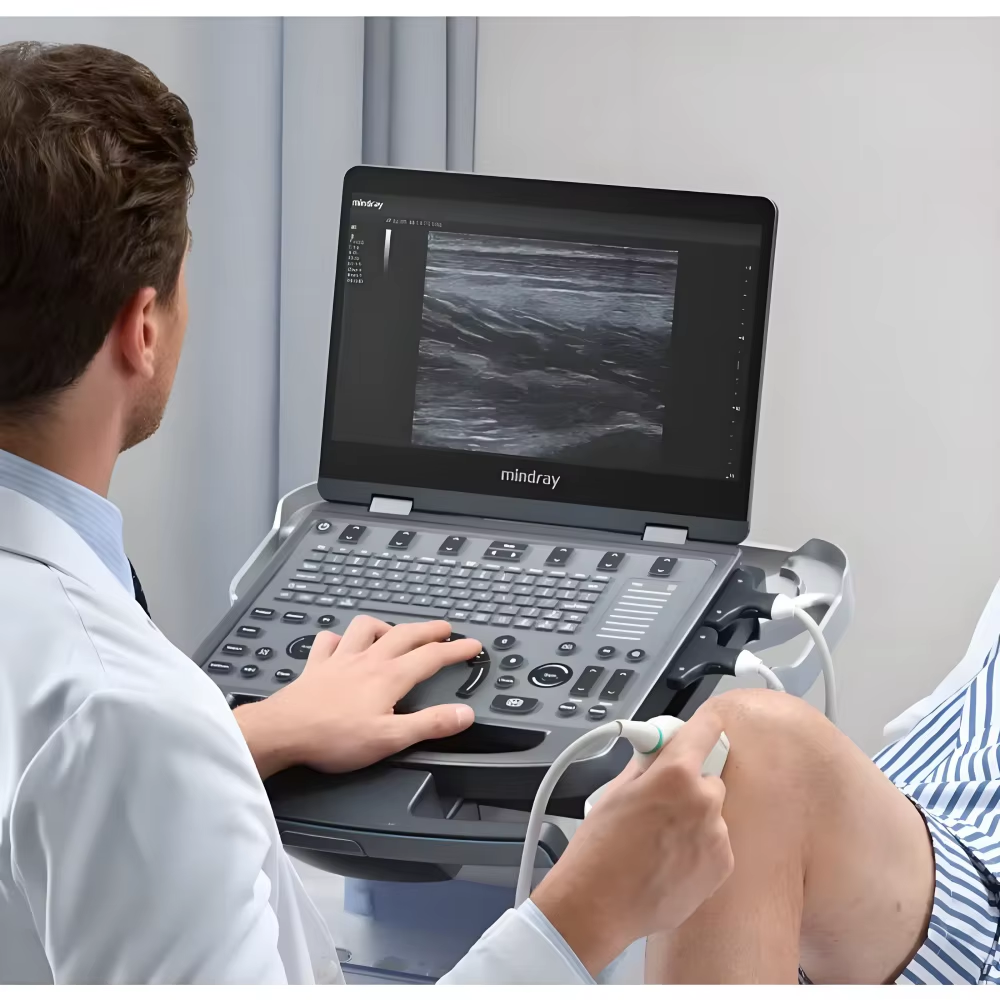
Instead of sending a patient to the imaging department, clinicians perform focused ultrasound examinations right at the patient’s bedside, in the emergency room, intensive care unit, operating theatre, outpatient clinic, or even in remote healthcare settings.
The goal is simple:
Answer an immediate clinical question that helps guide treatment decisions in real time.
Examples include:
- Is there fluid around the heart?
- Is the bladder full?
- Is there internal bleeding?
- Does this patient have pneumonia?
- Is the baby in the correct position?
- Can I safely insert this central line?
POCUS allows clinicians to diagnose faster and begin treatment sooner.
Why POCUS Is Transforming Healthcare
Healthcare facilities increasingly adopt POCUS because it offers:
- Faster diagnosis
- Improved patient safety
- Reduced waiting times
- Better emergency care
- Increased procedural accuracy
- Fewer unnecessary referrals
- Enhanced rural healthcare delivery
This is especially valuable in:
- Emergency departments
- Intensive Care Units
- Operating theatres
- Ambulances
- Rural hospitals
- Maternity units
- Medical outreach programs
What Is Doppler Ultrasound?


Doppler is a specialized ultrasound mode that measures movement, particularly blood flow.
Instead of simply producing images, Doppler tells clinicians:
- How fast blood is flowing
- Which direction blood is flowing
- Whether vessels are blocked
- Whether valves are functioning properly
- Whether circulation is adequate
This information is critical for diagnosing vascular and cardiac conditions.
Types of Doppler
Color Doppler
Shows blood flow using color overlays.
Typically:
- Red = flow toward the probe
- Blue = flow away from the probe
(The colors indicate direction relative to the probe—not whether the blood is oxygen-rich or oxygen-poor.)
Spectral Doppler
Measures blood flow velocity and produces waveforms for detailed analysis.
Power Doppler
Highly sensitive for detecting slow blood flow in small vessels.
Common Doppler Applications
Clinicians use Doppler to evaluate:
- Deep vein thrombosis (DVT)
- Peripheral arterial disease
- Carotid artery disease
- Cardiac valve disorders
- Fetal circulation
- Placental blood flow
- Organ perfusion
- Renal artery disease
POCUS vs Ultrasound vs Doppler
| Feature | POCUS | Ultrasound | Doppler |
|---|---|---|---|
| What is it? | A bedside clinical approach using ultrasound | The imaging technology | A specialized ultrasound mode |
| Main purpose | Rapid clinical decision-making | Comprehensive diagnostic imaging | Assess blood flow and circulation |
| Where used | Bedside, emergency, ICU, clinics | Imaging departments, hospitals, clinics | Built into many ultrasound systems |
| Examination | Focused | Comprehensive | Flow-focused |
| Typical users | Emergency physicians, intensivists, anesthetists, obstetricians, family physicians | Sonographers and radiologists | Sonographers and clinicians trained in vascular or cardiac imaging |
| Time required | Minutes | Longer, depending on the study | Integrated into ultrasound examinations |
Which One Does Your Facility Need?
The answer depends on the level of care you provide.
Primary Care Clinics
POCUS can significantly improve:
- Rapid diagnosis
- Maternal care
- Basic cardiac assessment
- Emergency evaluation
County Hospitals
A comprehensive ultrasound system with Doppler capabilities supports:
- Radiology
- Obstetrics
- Gynecology
- Internal medicine
- Pediatrics
- Surgery
Referral Hospitals
Advanced ultrasound systems featuring:
- Color Doppler
- Cardiac imaging
- Vascular studies
- Elastography
- AI-assisted measurements
- 3D/4D imaging
provide the flexibility needed for specialized care.
Can One Machine Do All Three?
Yes—in many cases.
Modern ultrasound systems often support:
- Standard B-mode imaging
- Color Doppler
- Power Doppler
- Pulsed Wave Doppler
- Continuous Wave Doppler
- POCUS workflows (depending on portability and intended use)
The difference lies not only in the machine’s capabilities but also in how it is used and the clinical questions it is designed to answer.
Choosing the Right Solution Is About Outcomes
Purchasing imaging equipment should begin with understanding your clinical objectives.
Ask questions such as:
- What types of patients do we see most often?
- Which departments will use the system?
- Do we need bedside portability?
- Will we perform vascular or cardiac assessments?
- What level of imaging detail is required?
- How will this equipment improve patient care and workflow?
Answering these questions helps ensure your investment delivers long-term value.
The Medjet Perspective
At Medjet Hospital Supplies Ltd, we don’t simply supply imaging equipment—we work with healthcare facilities to identify solutions that align with their clinical goals, staffing, patient volumes, and budget.
Whether your organization is establishing a new diagnostic department, equipping an emergency unit with portable POCUS devices, or upgrading to advanced Doppler-enabled ultrasound systems, our focus is on providing reliable technology backed by expert guidance and after-sales support.
Because the right equipment is more than a purchase—it’s an investment in faster diagnoses, better clinical decisions, and improved patient outcomes.
Final Thoughts
Understanding the distinction between POCUS, Ultrasound, and Doppler empowers healthcare leaders to make informed procurement decisions.
- Ultrasound is the foundational imaging technology.
- POCUS is the focused, bedside application of ultrasound for immediate clinical decision-making.
- Doppler is a specialized ultrasound mode that evaluates blood flow and circulation.
Together, these capabilities are reshaping modern healthcare by enabling earlier diagnosis, more precise treatment, and improved patient care across hospitals, clinics, and outreach programs.
Ready to Find the Right Imaging Solution?
Whether you’re outfitting a rural clinic with a portable POCUS device or upgrading your hospital with an advanced Doppler-enabled ultrasound system, Medjet Hospital Supplies Ltd can help you choose technology that supports your clinicians and improves patient outcomes.
Talk to our team today to explore imaging solutions tailored to your facility’s needs.
Order from MJ Hospital Supplies today and get free delivery.
You can also follow us on our: Facebook Page: Mj Hospital Supplies for more updates.
Instagram Page:https://www.instagram.com/medjet_hospital/
Pinterest page: https://www.pinterest.com/mjhospitalsupplies/
Linked in page: https://www.linkedin.com/company/medjet-hospital-supplies-ltd/
Twitter Page: https://twitter.com/medjethospital