
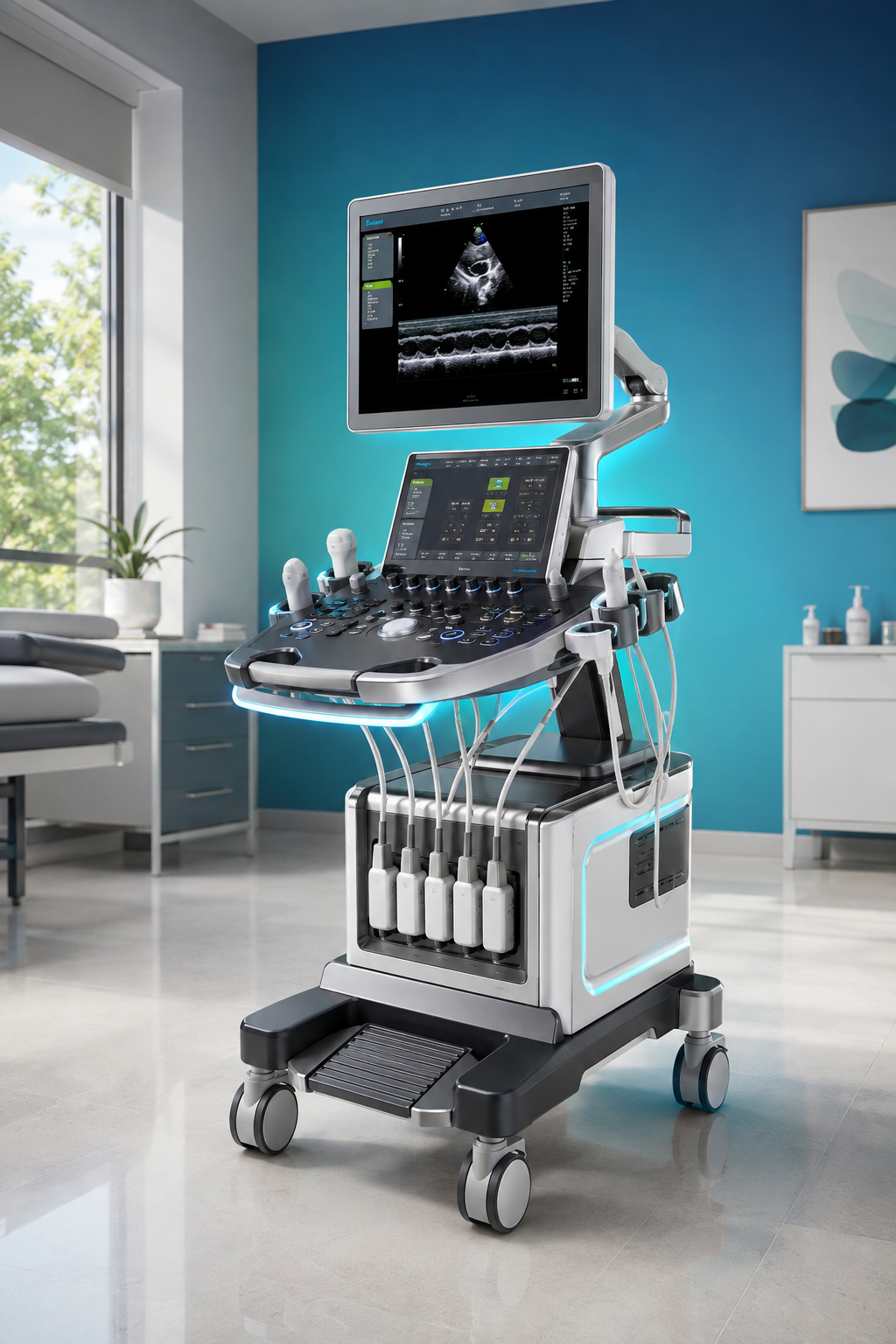
Ultrasound Machines
KSh2,000,000.00
Performance
Tissue doppler imaging (TDI) Auto IMT (intima-media thickness) Free hand elastography 3D/4D imaging Panoramic imaging Trapezoid imaging Anatomic M mode Auto-adaptive imaging processing
Categories Maternity Equipment, Medical Equipment
Ultrasound Machines in Kenya – Reliable Diagnostic Imaging Solutions
Make faster, more confident clinical decisions with high-quality
ultrasound machines in Kenya from Medjet Hospital Supplies.
We provide dependable ultrasound systems for
hospitals, clinics, maternity centres, diagnostic facilities
and mobile healthcare teams.
Our range includes portable ultrasound machines,
trolley-based colour Doppler systems, 3D/4D ultrasound machines
and specialised point-of-care ultrasound solutions.
Whether you need a compact unit for bedside examinations
or an advanced system for comprehensive imaging,
we can help you select a machine suited to your clinical needs, workload and budget.
Why Ultrasound Machines are Essential
An ultrasound machine uses high-frequency sound waves
to produce real-time images of structures inside the body.
Unlike imaging methods that use ionising radiation,
diagnostic ultrasound does not rely on X-rays.
It is widely used because it is non-invasive, versatile and
suitable for repeated examinations when clinically appropriate.
Healthcare professionals use ultrasound imaging to:
- Monitor pregnancy and foetal development
- Assess abdominal and pelvic organs
- Examine the heart and blood vessels
- Guide certain injections, biopsies and drainage procedures
- Evaluate muscles, tendons and other soft tissues
- Support emergency and critical-care assessments
- Investigate superficial organs and small body structures
The right system can improve workflow,
shorten examination times and extend diagnostic services
to more patients.
Types of Ultrasound Machines Available
Portable Ultrasound Machines
A portable ultrasound machine combines mobility with
dependable imaging capability. Its compact design makes it suitable
for outpatient clinics, maternity centres, emergency departments,
wards, ambulances and community outreach programmes.
Portable systems are especially useful when examinations must
be performed at the patient’s bedside or in facilities where space is limited.
Colour Doppler Ultrasound Machines
A colour Doppler ultrasound machine displays blood-flow information
alongside standard anatomical images. It can support vascular, cardiac, obstetric
and other examinations where circulation and tissue perfusion need to be assessed.
Depending on the model, imaging functions may include:
- B-mode imaging
- M-mode imaging
- Colour Flow Doppler
- Pulsed-Wave Doppler
- Power Doppler
- Continuous-Wave Doppler
- Tissue Doppler Imaging
3D and 4D Ultrasound Machines
A 3D ultrasound system creates three-dimensional images,
while a 4D ultrasound machine displays 3D images in real time.
These systems are commonly associated with obstetric imaging,
although their clinical applications depend on the available software,
transducers and system configuration.
They are ideal for facilities seeking advanced imaging capability
and an enhanced patient experience.
Point-of-Care Ultrasound Machines
Point-of-care ultrasound, commonly known as POCUS,
allows trained clinicians to perform focused examinations close to the patient.
These systems can support time-sensitive assessments in emergency medicine,
critical care, anaesthesia, internal medicine and primary care.
Compact POCUS machines may be laptop-based,
tablet-style or handheld, making them valuable for bedside
and field applications.
Trolley-Based Ultrasound Machines
Trolley-based systems are designed for departments with frequent
or specialised examinations. They may offer larger displays,
advanced imaging tools, multiple probe ports, improved ergonomics
and broader software packages.
These machines are suitable for busy imaging centres,
hospitals and specialist practices requiring consistent
performance throughout the working day.
Clinical Applications
Obstetric and Gynaecological Ultrasound
An obstetric ultrasound machine can assist qualified healthcare professionals
in monitoring pregnancy, evaluating foetal development
and examining the female reproductive system.
Common applications include:
- Pregnancy confirmation
- Foetal biometry and growth assessment
- Foetal heartbeat observation
- Placental location assessment
- Amniotic fluid evaluation
- Pelvic and gynaecological examinations
Abdominal Imaging
Abdominal ultrasound may be used to examine organs such as
the liver, gallbladder, kidneys, pancreas, spleen and urinary bladder.
Clear imaging and appropriate probe selection are important
for dependable abdominal examinations.
Cardiac Ultrasound
Echocardiography systems are configured
to assess the heart’s structures and function.
Cardiac examinations may require phased-array transducers,
specialised measurement packages and Doppler capabilities.
Vascular Ultrasound
Vascular ultrasound combines real-time imaging with
Doppler technology to evaluate blood vessels and blood-flow patterns.
A high-frequency linear probe is commonly used
for superficial vascular examinations.
Musculoskeletal Ultrasound
Musculoskeletal ultrasound can display muscles, tendons,
ligaments, joints and superficial soft tissues.
It is increasingly useful in orthopaedics, sports medicine,
physiotherapy, rheumatology and pain management.
Understanding Ultrasound Probes
An ultrasound machine’s performance is closely connected
to the type of transducer being used.
Choosing the correct probes ensures that the system
can support your intended examinations.
Convex Probe
A convex or curvilinear probe provides a broad field of view
and is commonly used for abdominal,
obstetric and gynaecological imaging.
Linear Probe
A linear probe operates at higher frequencies and
is generally used for vascular imaging, thyroid examinations,
breast imaging, musculoskeletal studies and other superficial structures.
Phased-Array Probe
A phased-array probe has a small footprint that makes
it suitable for cardiac examinations and imaging between the ribs.
Transvaginal Probe
A transvaginal probe is designed for detailed pelvic and
early obstetric examinations performed by trained healthcare professionals.
Micro-Convex Probe
A micro-convex probe combines a relatively
small footprint with a wider field of view.
Depending on its frequency and design,
it may be used for paediatric,
abdominal and selected interventional applications.
Features to Consider When Buying Ultrasound Machines
Before purchasing an ultrasound machine,
consider the following factors:
1. Intended Clinical Application
A system intended primarily for routine obstetric scans may require
a different configuration from one used for cardiology,
vascular imaging or point-of-care assessments.
Define your main examinations before comparing machines.
2. Image Quality
Look for a system that provides good contrast,
adequate penetration and clear visualisation of relevant anatomical structures.
Image optimisation technologies can also help
clinicians achieve more consistent results.
3. Required Probes
Confirm that the machine supports all the transducers your facility requires.
Also check whether the quoted price includes probes or
whether they are sold separately.
4. Doppler Capability
Basic black-and-white imaging may be sufficient for some routine examinations.
Facilities performing vascular,
cardiac or advanced obstetric imaging may require colour,
spectral and power Doppler functions.
5. Portability and Battery Operation
For bedside care, outreach work or facilities affected by power interruptions,
consider a system with a durable battery, compact construction
and a practical carrying or trolley solution.
6. Measurement and Reporting Software
Specialised calculation packages can make examinations more efficient.
Depending on your practice, you may need obstetric measurements,
cardiac calculations, vascular analysis or structured reporting tools.
7. Data Storage and Connectivity
Useful connectivity options may include USB export, DICOM compatibility,
network transfer, printer support and internal image storage.
Confirm compatibility with your facility’s existing systems before purchase.
8. Training and Technical Support
Reliable supplier support is just as important as the equipment itself.
Product orientation, application guidance,
warranty coverage and access to technical assistance can protect
your investment and reduce downtime.
Why Buy Ultrasound Machines from Medjet Hospital Supplies?
Medjet Hospital Supplies helps healthcare facilities access
dependable diagnostic equipment backed by professional product guidance.
When you purchase from us, you benefit from:
- A selection of portable and trolley-based ultrasound systems
- Solutions for different clinical applications and budgets
- Guidance on machine, probe and software selection
- Competitive ultrasound machine prices in Kenya
- Delivery arrangements across Kenya
- Product demonstrations where applicable
- Installation and user orientation depending on the system
- Warranty and after-sales support
- Access to compatible accessories and consumables
We focus on matching each facility with a practical solution
rather than simply supplying a machine.
Ultrasound Machines Prices in Kenya
The price of an ultrasound machine in Kenya depends on its imaging technology,
portability, probe configuration, software packages, brand and clinical capabilities.
A basic black-and-white portable unit generally costs less than a colour Doppler
or advanced 4D system. The final quotation may also vary according
to the number and type of probes, trolley, printer, battery capacity
and other accessories included.
Contact Medjet Hospital Supplies for a quotation based on your facility’s exact requirements.
Providing details about your intended examinations will help us recommend
a suitable and cost-effective configuration.
Who Can Benefit from Our Ultrasound Machines Systems?
Our ultrasound equipment is suitable for:
- Public and private hospitals
- Medical and diagnostic centres
- Maternity and reproductive health clinics
- General outpatient clinics
- Emergency and critical-care departments
- Cardiology and vascular practices
- Physiotherapy and sports medicine centres
- Mobile medical teams
- Community health and outreach programmes
- Training and educational institutions
Care and Maintenance Tips
Proper care can extend the working life of an ultrasound system
and help maintain consistent performance.
- Clean the machine and probes according to the manufacturer’s instructions.
- Do not pull, twist or tightly coil transducer cables.
- Use only approved cleaning and disinfection products.
- Keep probe connectors clean and dry.
- Protect the system from excessive heat, dust and moisture.
- Use suitable power protection where electrical supply is unstable.
- Arrange preventive maintenance and software checks as recommended.
- Stop using any probe that shows cracks, exposed wires or other damage.
Probes are sensitive and often costly to replace, so careful handling is particularly important.
Frequently Asked Questions
Which ultrasound machine is best for a clinic?
The best machine depends on the services offered by the clinic.
A general or maternity clinic may benefit from a portable colour Doppler system
with convex and linear probes. A specialist cardiac or vascular facility
may require dedicated software and additional transducers.
What is the difference between 2D, 3D and 4D ultrasound?
A 2D ultrasound produces conventional flat, real-time images.
A 3D system reconstructs multiple image slices into a three-dimensional view.
A 4D system displays three-dimensional images in real time.
Can one ultrasound machine perform different examinations?
Yes. Many machines can support several applications
when fitted with the correct probes and software.
However, not every model is suitable for every speciality,
so compatibility should be confirmed before purchase.
Do portable ultrasound machines produce clear images?
Modern portable systems can provide excellent image quality for many clinical applications.
Performance varies by model, probe, settings, operator skill and patient factors.
A demonstration can help you assess whether a particular system meets your requirements.
Does an ultrasound machines require a qualified operator?
Yes. Diagnostic examinations should be performed and interpreted
by appropriately trained healthcare professionals working within
their authorised scope of practice.
Do you deliver ultrasound machines outside Nairobi?
Medjet Hospital Supplies can arrange delivery to
healthcare facilities in Nairobi and other parts of Kenya.
Confirm the destination when requesting a quotation
so that delivery arrangements can be provided.
Request a Quote for an Ultrasound Machines in Kenya
Upgrade your facility with an ultrasound system selected for your clinical needs.
Whether you require a portable ultrasound machine,
colour Doppler ultrasound, 4D ultrasound system or POCUS solution,
Medjet Hospital Supplies is ready to guide you.
Contact us today for current pricing, available configurations
and professional assistance choosing the right machine.
Call or WhatsApp: +254792220281
Email: [email protected]
Location: Nairobi
Delivery: Available across Kenya
Order this Ultrasound Machines from MJ Hospital Supplies today and get free delivery.
You can also follow us on our: Facebook Page: Mj Hospital Supplies for more updates.
Instagram Page:https://www.instagram.com/medjet_hospital/
Pinterest page: https://www.pinterest.com/mjhospitalsupplies/
Linked in page: https://www.linkedin.com/company/medjet-hospital-supplies-ltd/
Twitter Page: https://twitter.com/medjethospital