
Why the Lowest Price Can Become the Most Expensive Decision
Every procurement team has experienced it.
A supplier submits a quotation that is significantly lower than everyone else’s. Budget pressures are high. Management wants to reduce costs. The temptation to choose the cheapest option feels almost irresistible.
On paper, it looks like smart financial management.
But six months later, the “savings” begin to disappear.
The patient monitor starts malfunctioning. The suction machine requires repeated repairs. Replacement parts are unavailable. Clinical staff lose confidence in the equipment. Downtime increases. Patients wait longer. Emergency purchases become necessary—and suddenly the hospital spends far more than it originally intended.
This scenario is becoming increasingly common in healthcare facilities across Kenya.
The real cost of medical equipment isn’t determined by the purchase price.
It’s determined by how much value that equipment delivers over its entire lifespan.
At Medjet Hospital Supplies Ltd, we’ve worked with county governments, private hospitals, faith-based organizations, NGOs, maternity facilities, and healthcare institutions across Kenya. We’ve seen firsthand that successful procurement teams don’t simply buy equipment—they invest in reliability, patient safety, and long-term operational efficiency.
This article explores the hidden costs that procurement teams often overlook and explains how to make smarter purchasing decisions that protect both budgets and patient outcomes.
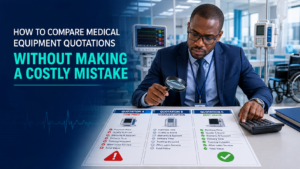
Price Is Only One Part of the Equation
Imagine two infant radiant warmers.
One costs KSh 420,000.
The other costs KSh 295,000.
Many procurement committees immediately focus on the KSh 125,000 difference.
But that’s only the beginning.
Ask these questions instead:
- How long will each machine last?
- Which supplier provides preventive maintenance?
- Are spare parts available locally?
- How quickly can repairs be completed?
- Does the warranty cover labour and replacement components?
- Will clinicians receive proper training?
- Does the equipment comply with Kenyan healthcare standards?
- What happens if the machine fails during patient care?
These questions determine the Total Cost of Ownership (TCO)—the true financial impact of purchasing medical equipment.
Hospitals that focus only on the initial purchase price often discover that they spend substantially more over the next five to ten years.
Understanding Total Cost of Ownership (TCO)
In healthcare procurement, Total Cost of Ownership refers to every expense associated with medical equipment throughout its lifecycle—not just the initial purchase.
A complete cost analysis should include:
- Purchase price
- Installation
- Staff training
- Preventive maintenance
- Repairs
- Spare parts
- Software updates
- Calibration
- Downtime costs
- Replacement costs
- Energy consumption
- Disposal or replacement at end of life
For example:
A patient monitor that appears inexpensive may require costly repairs every year.
Another monitor may cost slightly more initially but operate reliably for ten years with minimal maintenance.
Which one actually costs less?
The answer becomes obvious when procurement teams evaluate the equipment over its full lifespan.
Hidden Cost #1: Frequent Equipment Breakdowns
Medical equipment isn’t used occasionally.
It supports patient care every single day.
Every breakdown has consequences.
When an operating theatre light fails during surgery, procedures are delayed.
A fetal monitor stops functioning, maternity staff lose critical information.
An oxygen concentrator malfunctions, patient safety may be compromised.
These aren’t just technical issues.
They become operational, financial, and clinical challenges.
Repeated equipment failures often result in:
- Cancelled procedures
- Increased patient waiting times
- Reduced clinician confidence
- Emergency repair expenses
- Lower hospital productivity
- Damage to institutional reputation
Reliable equipment keeps healthcare services running without unnecessary interruptions.
Hidden Cost #2: Lack of Local Spare Parts
One of the biggest procurement mistakes is purchasing equipment without considering spare parts availability.
Many low-cost devices are imported with little or no after-sales support.
When a component fails:
- Replacement parts must be ordered internationally.
- Shipping delays extend downtime.
- Exchange rate fluctuations increase costs.
- Patients continue waiting.
Some hospitals ultimately replace entire machines simply because a small component cannot be sourced locally.
This turns a minor repair into a major capital expense.
Working with established medical equipment suppliers in Kenya ensures that spare parts, technical expertise, and maintenance support remain accessible when needed.
Hidden Cost #3: Poor After-Sales Support
Procurement should never end on delivery day.
The quality of after-sales service often determines whether equipment remains functional for years—or becomes an expensive storage item.
Strong suppliers provide:
- Equipment installation
- User training
- Preventive maintenance schedules
- Technical support
- Warranty management
- Calibration services
- Spare parts availability
- Rapid response during breakdowns
Hospitals should ask suppliers:
- How quickly can your engineers respond?
- Do you have local service teams?
- What maintenance packages are available?
- Do you provide annual servicing?
- How are warranty claims handled?
Reliable after-sales support significantly reduces long-term ownership costs.
Hidden Cost #4: Staff Training Gaps
Advanced medical equipment delivers value only when clinicians know how to use it effectively.
Without adequate training:
- Features remain unused.
- Incorrect operation causes avoidable failures.
- Equipment lifespan shortens.
- Diagnostic accuracy decreases.
- Patient care suffers.
Training should be viewed as part of the investment—not an optional extra.
Professional suppliers include comprehensive user training during installation, ensuring healthcare teams maximise the equipment’s capabilities from day one.
Hidden Cost #5: Increased Maintenance Costs
Every medical device requires maintenance.
However, maintenance costs vary dramatically depending on equipment quality.
Low-quality devices often require:
- More frequent servicing
- Higher repair costs
- More replacement components
- Increased technician visits
- Greater operational downtime
Reliable equipment generally follows predictable maintenance schedules, making budgeting easier and reducing unexpected expenses.
Preventive maintenance is far less expensive than emergency repairs.
Hidden Cost #6: Downtime That Disrupts Patient Care
Equipment downtime affects much more than the biomedical department.
It impacts the entire healthcare system.
Consider what happens when an ultrasound machine becomes unavailable:
- Patients are referred elsewhere.
- Revenue is lost.
- Waiting lists increase.
- Clinicians experience workflow disruptions.
- Patient satisfaction declines.
For busy hospitals, even one week of downtime can have significant financial consequences.
Reliable equipment protects service continuity.
Hidden Cost #7: Short Equipment Lifespan
Medical equipment should support healthcare delivery for many years.
Unfortunately, some low-cost products require replacement far earlier than expected.
Instead of lasting 10–15 years, they may become obsolete or unusable within just a few years.
Frequent replacement creates:
- Higher procurement costs
- Additional staff training
- New installation expenses
- Increased disposal costs
- Procurement delays
Choosing durable equipment reduces replacement frequency and maximises return on investment.
Hidden Cost #8: Compliance and Regulatory Risks
Healthcare facilities in Kenya operate within a regulated environment where equipment quality and safety are critical.
Equipment that lacks appropriate certifications or documentation may expose facilities to:
- Compliance challenges
- Safety concerns
- Audit findings
- Insurance complications
- Procurement disputes
Before purchasing medical equipment, verify:
- Manufacturer certifications
- Product quality standards
- Warranty documentation
- Technical manuals
- Service documentation
- Availability of calibration and maintenance records
Reliable suppliers help healthcare facilities remain compliant while protecting patient safety.
Kenya-Specific Procurement Challenges
Healthcare procurement in Kenya presents unique realities that procurement teams must consider.
County Government Procurement
County hospitals often operate under fixed annual budgets. While selecting the lowest-priced supplier may appear to stretch limited funds, recurring repair costs, emergency purchases, and prolonged downtime can quickly consume maintenance budgets.
Planning for the total cost of ownership helps county governments maximise the value of public investments.
Rural Healthcare Facilities
Hospitals located far from major cities face additional logistical challenges.
If equipment breaks down and spare parts or service engineers are unavailable locally, patients may lose access to essential healthcare services for weeks.
Selecting suppliers with nationwide technical support helps minimise these risks.
NGO and Donor-Funded Projects
Development partners increasingly evaluate sustainability—not just procurement costs.
Reliable equipment supported by maintenance plans and local service capacity ensures donor-funded investments continue delivering value long after project completion.
Private Healthcare Facilities
Private hospitals compete on patient experience, efficiency, and service quality.
Equipment failures directly affect patient confidence, operational efficiency, and revenue generation.
Investing in dependable medical equipment protects both clinical outcomes and business performance.
What Smart Procurement Teams Evaluate Before Buying
Successful procurement teams ask questions beyond price.
1. Supplier Reputation
How long has the supplier operated in Kenya?
Do they have successful installations?
Can they provide references?
2. Technical Support
Is technical assistance available locally?
How quickly are service calls handled?
3. Spare Parts Availability
Can replacement parts be sourced immediately?
Are they stocked locally?
4. Warranty Coverage
Does the warranty include labour?
What components are covered?
How long is the warranty period?
5. Preventive Maintenance
Does the supplier offer scheduled servicing?
Can maintenance contracts be customised?
6. User Training
Will clinicians receive practical operational training?
Are refresher sessions available?
7. Equipment Scalability
Can the equipment integrate with future hospital expansion?
Will software updates remain available?
Why Partnering with the Right Medical Equipment Supplier Matters
The relationship between a healthcare facility and its supplier extends far beyond procurement.
A dependable supplier becomes a long-term partner who helps ensure:
- Equipment reliability
- Clinical efficiency
- Patient safety
- Regulatory compliance
- Predictable maintenance costs
- Ongoing technical support
- Sustainable healthcare delivery
This partnership reduces operational risk while improving long-term value.
How Medjet Hospital Supplies Ltd Supports Smarter Procurement
At Medjet Hospital Supplies Ltd, we believe procurement should create lasting value—not short-term savings.
We work closely with healthcare institutions across Kenya to provide:
- High-quality medical equipment from trusted manufacturers
- Comprehensive product consultation
- Professional installation
- Clinical user training
- Preventive maintenance programmes
- Responsive after-sales support
- Spare parts availability
- Technical service and repairs
- Equipment lifecycle guidance
Our objective is simple:
To help healthcare facilities invest confidently in equipment that performs reliably for years while supporting exceptional patient care.
Frequently Asked Questions (FAQ)
Is buying the cheapest medical equipment always a bad decision?
Not necessarily. However, procurement decisions should consider reliability, maintenance, after-sales support, spare parts availability, and equipment lifespan—not just the purchase price.
What is Total Cost of Ownership in healthcare procurement?
Total Cost of Ownership (TCO) is the complete cost of owning medical equipment throughout its lifecycle, including purchase, installation, maintenance, repairs, training, energy use, spare parts, and eventual replacement.
Why is preventive maintenance important?
Preventive maintenance helps identify issues before they lead to equipment failure. It improves reliability, extends equipment lifespan, reduces emergency repair costs, and enhances patient safety.
How can hospitals reduce medical equipment downtime?
Hospitals can minimise downtime by purchasing quality equipment, partnering with reliable suppliers, scheduling preventive maintenance, ensuring staff training, and maintaining access to genuine spare parts.
What should I look for in medical equipment suppliers in Kenya?
Look for suppliers with proven industry experience, quality-certified products, local technical support, preventive maintenance services, available spare parts, product warranties, installation expertise, and strong after-sales service.
Why is after-sales support important?
After-sales support ensures equipment continues operating efficiently through maintenance, repairs, technical assistance, calibration, and user training, reducing operational disruptions and protecting your investment.
Final Thoughts
Healthcare procurement is about much more than purchasing equipment.
Every procurement decision affects clinicians, patients, hospital operations, and financial sustainability.
Choosing equipment based solely on the lowest price often leads to higher maintenance costs, increased downtime, repeated replacements, and avoidable operational challenges.
The most successful healthcare facilities evaluate long-term value, clinical reliability, and supplier partnership alongside cost.
When procurement teams adopt a Total Cost of Ownership approach, they make investments that improve patient care, protect public resources, and strengthen healthcare delivery for years to come.
If your hospital, county government, NGO, or private healthcare facility is planning to invest in new medical equipment, partner with a supplier that understands the full lifecycle of healthcare technology.
Medjet Hospital Supplies Ltd is committed to helping healthcare providers across Kenya make informed procurement decisions through quality equipment, dependable technical support, and long-term service partnerships—because the true value of medical equipment is measured not by what it costs today, but by how well it serves patients tomorrow.
Order from MJ Hospital Supplies today and get free delivery.
You can also follow us on our: Facebook Page: Mj Hospital Supplies for more updates.
Instagram Page:https://www.instagram.com/medjet_hospital/
Pinterest page: https://www.pinterest.com/mjhospitalsupplies/
Linked in page: https://www.linkedin.com/company/medjet-hospital-supplies-ltd/
Twitter Page: https://twitter.com/medjethospital
Medical Equipment: https://mjhospitalsupplies.co.ke/product-category/medical-equipment/
Preventive Maintenance Program:https://mjhospitalsupplies.co.ke/why-preventive-maintenance-is-becoming-mandatory-for-kenyan-hospitals-this-year/
Portable Ultrasound:https://mjhospitalsupplies.co.ke/product/portable-ultrasound-machine/
Infant Warmer:https://mjhospitalsupplies.co.ke/product/infant-radiant-warmer-bn-100/
Phototherapy Unit:https://mjhospitalsupplies.co.ke/product/newborn-phototherapy/
Patient Monitor: https://mjhospitalsupplies.co.ke/product/patient-monitor-6-parameter/
Theatre Equipment:https://mjhospitalsupplies.co.ke/product-category/operating-theatre-equipment/
ICU Equipment:https://mjhospitalsupplies.co.ke/product-category/icu-equipment/
Maternity Equipment: https://mjhospitalsupplies.co.ke/product-category/maternity-equipment/