Compare Medical Equipment Quotations
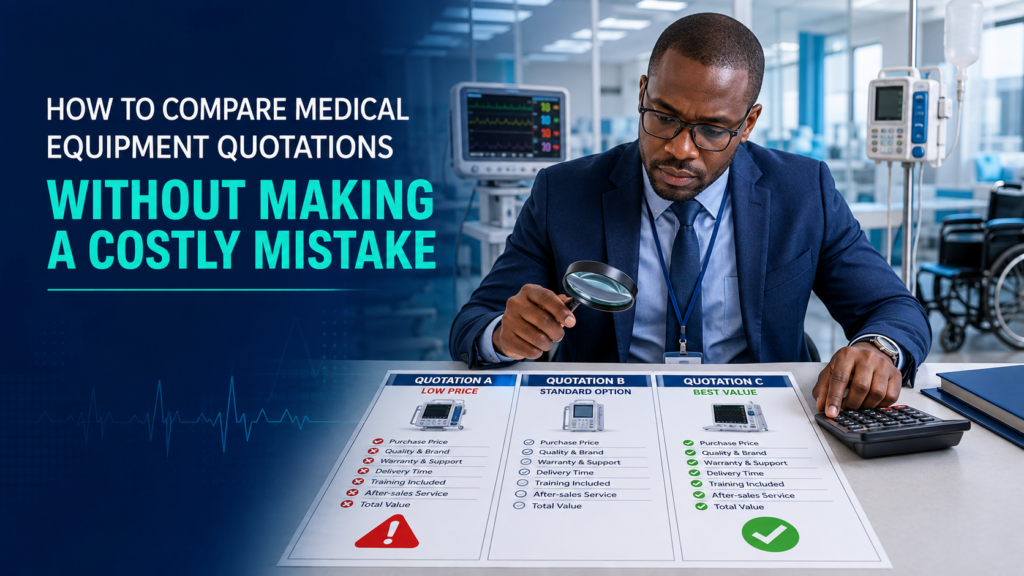
How to Compare Medical Equipment Quotations Without Making a Costly Mistake
Choosing the lowest-priced medical equipment quotation may appear to save money—but it can create much larger expenses later.
Two suppliers may quote what appears to be the same patient monitor, hospital bed, autoclave or ultrasound machine, yet their offers could differ significantly in configuration, clinical capability, warranty, installation, training and after-sales support. A quotation that initially looks expensive may deliver better long-term value, while a cheaper offer may exclude essential items required to use the equipment safely and effectively.
Healthcare facilities should therefore compare quotations based on total value, not price alone. Here is a practical framework for making a well-informed procurement decision.
1. Confirm That Every Supplier Is Quoting the Same Requirement
A fair comparison is only possible when all suppliers are responding to the same specifications.
Product names can be misleading. Two machines described as “five-parameter patient monitors,” for example, may have different screen sizes, accessories, monitoring capabilities, data-storage functions or operating environments.
Before comparing prices, check:
- Manufacturer, brand and exact model
- Intended clinical application
- Equipment dimensions and capacity
- Measurement range and accuracy
- Power and battery requirements
- Included accessories
- Optional features
- Applicable quality or regulatory documentation
- Compatibility with existing equipment and infrastructure
Prepare a compliance checklist and assess every quotation against it. If a supplier substitutes a different specification, request clarification before proceeding.
2. Separate Standard Accessories from Optional Extras
A low quotation may cover the main unit while excluding accessories that are necessary for routine use.
Depending on the product, important components may include:
- Patient cables and probes
- Batteries and chargers
- Trolleys, stands or mounting brackets
- Reusable or disposable sensors
- Printer modules and paper
- Regulators, hoses or connectors
- Software licences
- Starter consumables
- User and service manuals
Ask each supplier to clearly identify what is included, what is optional and what must be purchased separately. The equipment may be attractively priced but unusable on arrival because a critical accessory was omitted.
The right question is not simply, “How much does the machine cost?” It is, “How much will it cost to place this machine into clinical service?”
3. Compare Technical Compliance, Not Marketing Language
Words such as advanced, high quality, digital and multipurpose do not provide enough information for an objective decision.
Request a technical datasheet and compare measurable features. Depending on the equipment, these may include:
- Accuracy and resolution
- Patient or load capacity
- Battery operating time
- Alarm functions
- Sterilisation temperature and cycle options
- Image quality and available probes
- Irradiance, flow rate or output range
- Data storage and connectivity
- Environmental operating conditions
- Safety features
Every critical requirement should receive a clear response: compliant, partially compliant or non-compliant. Unsupported claims should not be treated as confirmed specifications.
4. Calculate the Total Cost of Ownership
The purchase price is only the beginning of the equipment’s financial impact.
Total cost of ownership considers all expenses likely to arise during the expected period of use. These can include:
- Delivery and insurance
- Installation and commissioning
- Site preparation
- Staff training
- Preventive maintenance
- Calibration and testing
- Consumables
- Replacement accessories
- Software subscriptions
- Spare parts
- Corrective repairs
- Energy consumption
- Decommissioning or disposal
A machine costing KSh 300,000 may ultimately be more expensive than one costing KSh 380,000 if it requires costly proprietary consumables, frequent repairs or imported replacement parts.
A simplified calculation is:
Total cost of ownership = purchase price + installation + training + consumables + maintenance + repairs + other operating costs
Where possible, compare these costs over three to five years rather than evaluating only the initial invoice.
5. Examine the Warranty Carefully
A warranty should be assessed by its coverage—not merely its duration.
One supplier may offer a two-year warranty covering parts and labour, while another offers the same period but excludes batteries, probes, sensors and transport. These warranties do not offer equal protection.
Confirm the following in writing:
- Warranty start and end dates
- Parts covered
- Parts excluded
- Labour charges
- Transport or call-out fees
- Response time
- Repair location
- Availability of replacement equipment
- Actions that may invalidate the warranty
Also establish whether the warranty is supported locally by the supplier or depends on returning the equipment to an overseas manufacturer.
6. Assess After-Sales and Technical Support
Medical equipment can affect clinical workflow and service continuity. When a device develops a fault, the speed and quality of technical support matter.
Ask suppliers:
- Do you have trained technical personnel?
- Where is your service team located?
- What is your typical response time?
- Are spare parts available locally?
- Can you provide preventive maintenance?
- Do you offer calibration or performance verification?
- For how many years will parts and support remain available?
- Is remote technical assistance available?
A strong supplier relationship continues after delivery. Reliable after-sales support may justify a higher initial price because it reduces downtime and protects the facility’s investment.
7. Verify Installation, Commissioning and Training
Some equipment requires more than delivery. It may need assembly, electrical checks, calibration, configuration, performance testing and user training before it can be safely introduced into service.
The quotation should state whether the supplier will provide:
- Site assessment
- Delivery to the final installation point
- Assembly and installation
- Functional and safety testing
- Calibration where applicable
- User training
- Biomedical or technical training
- Commissioning documentation
- Handover certificates
Training should cover correct operation, cleaning, basic troubleshooting, alarm management and actions that could damage the equipment or void the warranty.
8. Check Delivery Time and Stock Availability
A lower price is not helpful if the equipment arrives after it is needed.
Distinguish between:
- In stock: Available for dispatch
- Available locally: May still require transfer or preparation
- On order: Dependent on an existing shipment
- Available on request: Procurement may begin only after payment
- Estimated lead time: Subject to manufacturing, freight or customs delays
Ask for a firm delivery schedule and clarify whether it begins from the purchase order date, deposit date or receipt of full payment. For urgent requirements, consider the operational cost of waiting.
9. Review Payment and Commercial Terms
Quotations with the same total price may create different financial risks.
Compare:
- Required deposit
- Balance-payment stage
- Credit terms
- Quotation validity
- Currency and exchange-rate conditions
- Applicable taxes
- Delivery charges
- Installation fees
- Cancellation terms
- Ownership transfer conditions
Ensure all costs are clearly stated. Phrases such as “installation charged separately” or “transport at client’s cost” can significantly alter the final amount.
10. Evaluate the Supplier—not Just the Equipment
A genuine product can still become a poor investment when supplied without documentation, technical competence or reliable support.
Before awarding the order, consider:
- Supplier registration and business legitimacy
- Experience with the equipment category
- Manufacturer or distributor relationship
- Availability of technical personnel
- References from similar healthcare facilities
- Quality of product documentation
- Responsiveness during the quotation process
- Ability to supply consumables and spare parts
Be cautious when a supplier avoids technical questions, provides inconsistent model information or pressures you to pay before confirming what is included.
11. Request a Demonstration Where Practical
A demonstration can reveal issues that are difficult to identify from a brochure.
Invite the intended users, biomedical personnel, infection-prevention team and procurement representatives where relevant. During the demonstration, assess:
- Ease of operation
- Display visibility and control layout
- Alarm clarity
- Cleaning requirements
- Mobility and stability
- Accessory connections
- Workflow suitability
- Build quality
- Availability of required functions
Use a standard evaluation form so that every demonstrated model is judged against the same criteria.
12. Use a Weighted Quotation Evaluation Matrix
Price should be important, but it should not automatically determine the winner. A weighted matrix helps make the decision more transparent.
| Evaluation area | Suggested weight |
|---|---|
| Technical compliance | 30% |
| Total cost of ownership | 20% |
| Warranty and after-sales support | 15% |
| Product quality and documentation | 10% |
| Delivery and installation | 10% |
| Training and user support | 5% |
| Supplier experience and reliability | 5% |
| Commercial terms | 5% |
The weights should be adjusted according to the facility and equipment. Technical compliance and service capacity may deserve greater emphasis for critical-care equipment than for simple, low-risk products.
A supplier should not compensate for failure to meet a mandatory clinical or safety requirement merely by offering a lower price.
Warning Signs in a Medical Equipment Quotation
Investigate further if you notice:
- No manufacturer or model number
- A vague description of included accessories
- Missing technical datasheets
- No clear warranty terms
- Unusually low pricing without an explanation
- Large advance payment with unclear delivery commitments
- No installation or commissioning provision
- No evidence of technical support
- Unclear spare-parts availability
- Conflicting information across the quotation and brochure
- Pressure to make an immediate decision
These signs do not automatically prove that an offer is unsuitable, but they justify careful verification.
Questions to Ask Before Approving a Quotation
Before issuing a purchase order, confirm:
- Does the proposed model meet every mandatory requirement?
- Is the equipment appropriate for its intended users and clinical environment?
- Are all essential accessories included?
- What additional purchases will be required?
- Is installation and commissioning included?
- Who will train the users?
- What exactly does the warranty cover?
- How quickly can the supplier respond to a breakdown?
- Are consumables and spare parts readily available?
- What will the equipment cost to own and operate over several years?
- Is the delivery timeline acceptable?
- Have the supplier’s claims been supported by appropriate documentation?
Final Thoughts
The best medical equipment quotation is not necessarily the cheapest or the most expensive. It is the offer that meets the clinical requirement, includes everything needed for operation, provides dependable support and delivers the strongest long-term value.
A disciplined comparison process protects more than the facility’s budget. It reduces equipment downtime, prevents unexpected expenses, supports healthcare workers and contributes to safer, more reliable patient care.
When quotations are evaluated on technical compliance, lifecycle costs, warranty, training and supplier capability, procurement becomes a strategic clinical decision—not simply a search for the lowest price.
Need help selecting dependable medical equipment for your healthcare facility? Contact Medjet Hospital Supplies for product guidance, transparent quotations and after-sales support tailored to your requirements.
Order from MJ Hospital Supplies today and get free delivery.
You can also follow us on our: Facebook Page: Mj Hospital Supplies for more updates.
Instagram Page:https://www.instagram.com/medjet_hospital/
Pinterest page: https://www.pinterest.com/mjhospitalsupplies/
Linked in page: https://www.linkedin.com/company/medjet-hospital-supplies-ltd/
Twitter Page: https://twitter.com/medjethospital
Related Articles

2026 Maternity Equipment Checklist for Clinics and Hospitals in Kenya
August 3, 2026
No Comments
Read More »
First 10 Minutes of a Medical Emergency: Is Your Facility Ready?
July 27, 2026
No Comments
Read More »

Why Preventive Maintenance Is One of the Best Investments a Hospital Can Make
July 13, 2026
No Comments
Read More »