
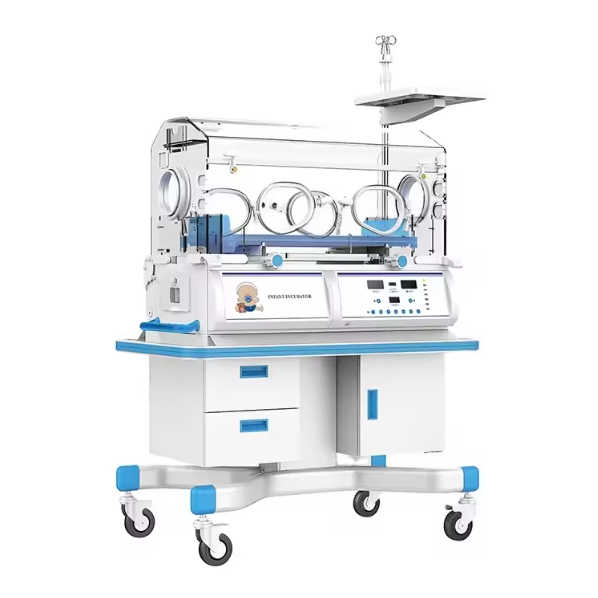
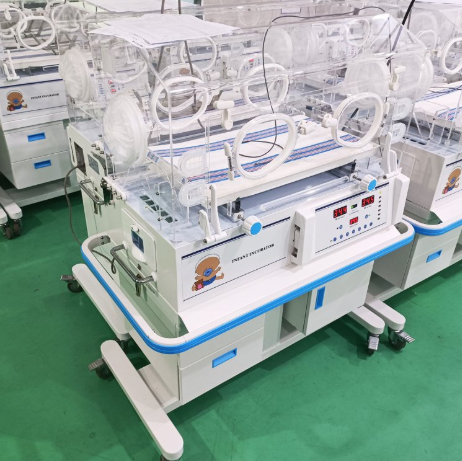
Transport NICU Incubator
KSh350,000.00
Product Feature & Specification
Infant Incubator BIN-3000B (1) Electric Requirement: 220V, 50Hz or 230V 60Hz Air over temp range: <38.0°C Air mode high temp range: 37.1°C-39.0°C Power Consumption: ≤450VA Skin mode high temp range: 37.1°C-38.0°C High temp mode alarm: <40.0°C Air mode temp range: 25.0°C-37.0°C Air mode alarm: ±3.0°C Skin mode Alarm: ±1.0°C Skin mode temp range: 34.0°C-37.0°C Skin sensor accuracy: ≤±0.3°C Air control accuracy: ≤0.5°C Mattress temp uniformity: ≤0.8°C Noise: ≤55dB(A)
Categories Maternity Equipment, Newborn Unit
Transport NICU Incubator
Safe, Stable Neonatal Care While Every Second Counts
Moving a newborn who needs intensive care is never just a routine transfer.
Whether the journey is between hospital departments or from one healthcare facility to another,
the baby requires a carefully controlled environment throughout the trip.
A Transport NICU Incubator provides continuous warmth,
protection and clear visibility during neonatal transportation.
Designed for premature, low-birth-weight and medically vulnerable newborns,
it helps clinical teams maintain essential care while
transferring infants by ambulance or within a hospital.
At Medjet Hospital Supplies, we provide reliable
neonatal transport incubators for hospitals, maternity centres, NICUs,
ambulance services and emergency response teams across Kenya.
What Is a Transport NICU Incubator?
A Transport NICU Incubator—also called a
neonatal transport incubator or infant transport incubator—
is a mobile medical unit designed to create a
controlled environment around a newborn during transfer.
Unlike a standard stationary incubator,
a transport model is engineered for mobility.
It may incorporate battery operation, temperature monitoring,
oxygen-cylinder mounting points and space
for essential neonatal equipment.
The exact configuration depends on the selected model.
Its enclosed transparent canopy helps reduce exposure
to cold air, dust and unnecessary handling while allowing
medical personnel to observe the infant throughout the journey.
Why Temperature Control Is Critical During Neonatal Transport
Premature and low-birth-weight babies can lose
body heat much faster than healthy full-term infants.
During transport, changing environmental conditions
may increase the risk of heat loss.
A properly operated transport incubator helps maintain a
stable thermal environment from departure to arrival.
This gives healthcare professionals greater confidence while
moving an infant who requires close observation and
uninterrupted support.
Key Features of Transport NICU Incubator
Depending on the model and configuration,
a Transport NICU Incubator may include:
- Electronically controlled air-temperature system
- Clear, double-walled infant canopy
- Easy-to-read digital display
- Integrated temperature sensors
- Visual and audible safety alarms
- Access ports for clinical procedures
- Convenient infant-access doors
- Rechargeable battery for mobile operation
- AC and vehicle power compatibility
- Oxygen-cylinder holders
- Secure stretcher or trolley mounting system
- Storage space for accessories and emergency supplies
- Adjustable IV pole
- Smooth-rolling trolley with locking castors
- Space for compatible monitoring or respiratory equipment
Please confirm the specifications of your preferred model before ordering.
Safety Alarm Functions
A quality neonatal transport incubator may alert users to conditions such as:
- Temperature above or below the selected range
- Sensor failure
- Fan or airflow problems
- Power interruption
- Low battery
- System malfunction
These alarms support timely clinical intervention
but do not replace continuous observation by
appropriately trained medical personnel.
Designed for Practical Clinical Use
Reliable warmth during transfer
The temperature-control system helps reduce unnecessary
heat loss while an infant is being transported.
Clear infant visibility
The transparent canopy allows healthcare professionals
to observe the baby without repeatedly opening the enclosure.
Access when care cannot wait
Well-positioned access ports enable clinicians to reach the
infant and manage compatible tubing or monitoring leads
with minimal disruption.
Flexible power options
Selected models can operate using mains electricity,
a vehicle power source or an internal rechargeable battery,
supporting continuity during different stages of transport.
Secure mobility
A stable trolley or stretcher platform helps
simplify movement through corridors, lifts, ambulance bays
and emergency departments.
Where Can a Neonatal Transport Incubator Be Used?
Transport incubators are suitable for:
- Neonatal intensive care units
- Maternity and delivery departments
- Paediatric hospitals
- Ambulance and emergency medical services
- Inter-hospital neonatal transfers
- Intra-hospital transfers
- Referral hospitals
- Private and public healthcare facilities
Who May Require Transport in an Incubator?
A neonatal transport incubator may be used for newborns
who require a controlled environment during transfer, including:
- Premature babies
- Low-birth-weight infants
- Newborns requiring specialised neonatal care
- Infants needing close temperature observation
- Babies transferred after delivery
- Newborns referred to a higher-level medical facility
The decision to use an incubator and the
required supportive equipment should always be made by
qualified healthcare professionals.
Benefits for Healthcare Facilities
Investing in a dependable Transport NICU Incubator
can help a healthcare facility:
- Strengthen neonatal referral services
- Support safer movement of vulnerable newborns
- Maintain a controlled thermal environment during transfer
- Improve coordination between maternity, emergency and NICU teams
- Expand neonatal emergency-response capability
- Reduce unnecessary exposure and handling during transportation
Choosing the Right Transport Incubator
Before purchasing, consider:
Power supply: Confirm battery duration and
compatibility with mains and ambulance power.
Temperature controls: Look for simple controls,
visible readings and appropriate alarm functions.
Transport platform: Ensure the trolley or stretcher is stable
and suitable for the intended vehicle.
Accessory compatibility: Check whether oxygen cylinders, monitors,
IV stands or other equipment can be mounted securely.
Cleaning requirements: Choose surfaces that are accessible
and suitable for routine infection-control procedures.
Service support: Ask about installation, user orientation,
spare parts and after-sales assistance.
Facility needs: Select the configuration according to
transfer distance, available clinical team and level of neonatal care.
Why Buy from Medjet Hospital Supplies?
We understand that neonatal equipment must
support both delicate patients
and the professionals caring for them.
Our team helps healthcare facilities identify equipment
that matches their clinical requirements,
available infrastructure and budget.
When you choose Medjet Hospital Supplies,
you benefit from:
- Professional product guidance
- Quality neonatal-care equipment
- Competitive pricing
- Delivery arrangements across Kenya
- Responsive customer customer support
- Assistance with equipment specifications and quotations
Request a Transport NICU Incubator Quote
Give your neonatal team equipment designed to support warmth,
visibility and continuity of care during critical transfers.
Contact Medjet Hospital Supplies today for the
Transport NICU Incubator price in Kenya,
product specifications, availability and delivery information.
Frequently Asked Questions
What is the difference between a transport incubator and a standard infant incubator?
A standard infant incubator is primarily intended for use in a neonatal unit.
A transport incubator is designed for mobility and
may include battery power, vehicle-power compatibility,
equipment mounts and a transport trolley.
Can a Transport NICU Incubator be used inside an ambulance?
Selected models are designed for ambulance use when installed on a compatible,
properly secured transport system.
Confirm vehicle compatibility and applicable requirements before use.
How long does the incubator operate on battery power?
Battery operating time differs between models
and depends on settings, battery condition and connected equipment.
Check the manufacturer’s technical specifications for the selected unit.
Does the incubator come with an oxygen cylinder?
This depends on the supplied configuration.
Some models include oxygen-cylinder holders,
while cylinders and regulators may be supplied separately.
Can it transport premature babies?
Transport incubators are commonly used
when transferring premature and low-birth-weight infants.
The baby must remain under the care of trained neonatal
or emergency medical personnel.
How do I get the current price in Kenya?
Contact Medjet Hospital Supplies with your required configuration.
We will provide current pricing, specifications and delivery information.
Order from MJ Hospital Supplies today and get free delivery.
You can also follow us on our: Facebook Page: Mj Hospital Supplies for more updates.
Instagram Page:https://www.instagram.com/medjet_hospital/
Pinterest page: https://www.pinterest.com/mjhospitalsupplies/
Linked in page: https://www.linkedin.com/company/medjet-hospital-supplies-ltd/
Twitter Page: https://twitter.com/medjethospital